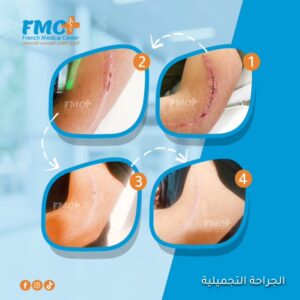
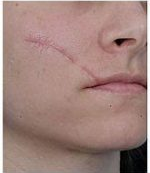
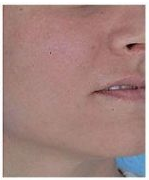
Scars: These are changes in skin color accompanied by disturbances in the regularity of its surface. This disturbance results from an injury to the skin, whether it is from a cut accident, burns, or a severe skin infection that caused blisters and inflammations in the skin, such as acne or chickenpox, leaving its mark on the skin.
Wound cosmetic surgery
Types of Scars:
1. Hypertrophic Scar
See main article: Hypertrophic Scar
Hypertrophic scars occur when the body produces excess collagen, causing a raised scar above the surrounding skin. Hypertrophic scars appear as raised, red lumps on the skin. They typically develop within 4-8 weeks after a wound infection, excessive wound closure, and/or other traumatic skin injuries.
2. Keloid Scar
See main article: Keloid
Keloid scars. People with darker skin tones are more prone to developing keloid scars.
Keloid scars are the most serious form of excessive scarring because they can grow indefinitely into large (benign) tumors.
Hypertrophic scars are often distinguished from keloid scars because they do not grow beyond the original wound area, but this distinction can often lead to confusion during examination. Keloid scars can occur on anyone, but they are most common in people with darker skin tones. They can be caused by surgery, accidents, acne, or sometimes body piercing, and in some people, keloid scars form spontaneously. Although they can be a cosmetic concern, keloids are simply inert clumps of collagen and are therefore completely harmless and non-cancerous. However, they can be itchy or painful for some individuals and tend to be most common on the shoulders and chest. Keloids and hypertrophic scars tend to be more common in wounds that have closed with secondary tissue. Surgical removal of keloids is risky and may worsen the condition.
3. Atrophic Scar
An atrophic scar takes the form of a sunken depression in the skin and is caused by the loss of underlying supporting structures for the skin, such as fat or muscle. This type of scar is often associated with acne, chickenpox, other illnesses (particularly staph infections), surgery, insect and spider bites, and accidents. It can also be caused by inherited connective tissue disorders, such as Ehlers-Danlos syndrome.
4. Stretch Marks
Crystal Clear app kdict.png Main article: Micro-wrinkles
Stretch marks (or striae) are also a form of scarring caused by rapid stretching of the skin (for example, during pregnancy, significant weight gain, and adolescent growth spurts), or when the skin is subjected to tension during the healing process (usually near joints). The appearance of this type of scar usually improves after a few years.
Elevated levels of corticosteroids are implicated in the development of striae.
5. Navel Scar
Humans and other placental mammals have a navel scar (commonly referred to as the umbilical cord) that begins to heal when the umbilical cord is cut after birth. In addition to placental mammals, egg-laying animals have an umbilical scar that usually disappears within a few days after birth or remains visible for life, depending on the species.
Scar Treatment: Scars can disrupt our lives, forcing us to hide them or undergo scar treatment to remove them. This is especially true for minor or major injuries and wounds, particularly during childhood and adolescence. In young adulthood, many people suffer from acne and oily skin, which can leave behind unwanted marks and unsightly scars on our faces or other parts of our bodies. Tajmeeli, your guide to the world of cosmetic procedures, provides you with all the information you need about scar removal and how to get rid of them.
1. Scar treatment using topical creams.
2. Scar treatment with laser.
3. Scar treatment with fractional laser.
4. Scar treatment with fillers and other dermal fillers.
5. Scar treatment with surgical methods, including scar excision and skin grafting.
1. Laser scar removal is a simple procedure with a short recovery period, allowing patients to return to their normal activities within one day of the procedure.
2. Surgical scar removal, on the other hand, may require a recovery period of up to two weeks, depending on the location and size of the scar and the surgical technique used, whether it involves skin tightening or tissue grafting.
3. Generally, patients must rest completely during the post-operative period and strictly adhere to the doctor's instructions. In the case of laser scar treatment, patients should avoid direct sunlight on the treated area.
4. Patients should use soothing and anti-inflammatory topical creams and take the prescribed medications regularly to reduce swelling and pain.
5. The same instructions apply to the recovery period after surgery, with the additional requirement that the bandage not be removed until a period determined by the doctor based on the condition, location, and size of the wound.
6. Surgical scar treatment methods include scar excision and skin grafting.
**Anesthesia:** The first step, just as with any surgical procedure, is anesthesia. The doctor may use local anesthesia alone, local anesthesia with a sedative, or general anesthesia. The doctor decides on the type of anesthesia after consulting with the patient, understanding their medical history, and confirming their readiness to undergo the procedure while awake.
**Surgical Incision:** In cases of deeper scars, the doctor may need to make an incision to remove layers of damaged cells, allowing a new, healthy layer of skin to grow. Skin grafting may also be necessary to cover the scar.
This tissue can be obtained during skin tightening procedures from other parts of the body, through tissue grafting techniques that allow for the growth of a skin graft, or even from donors whose tissue is compatible with the patient's.
**Wound Closure:** The wound is closed, and the recovery period begins. This involves using certain medications and avoiding sun exposure. In surgical cases, a dressing may be required for a period of time. In other treatment cases, medication and topical creams are used.
Surgical treatment is often successful in treating the most difficult cases where laser scar treatment fails. However, it takes between two weeks and several weeks for the individual to begin recovering from the effects of the procedure, for swelling and bruising to subside, for bandages to be removed, and for significant scar reduction to become visible.