


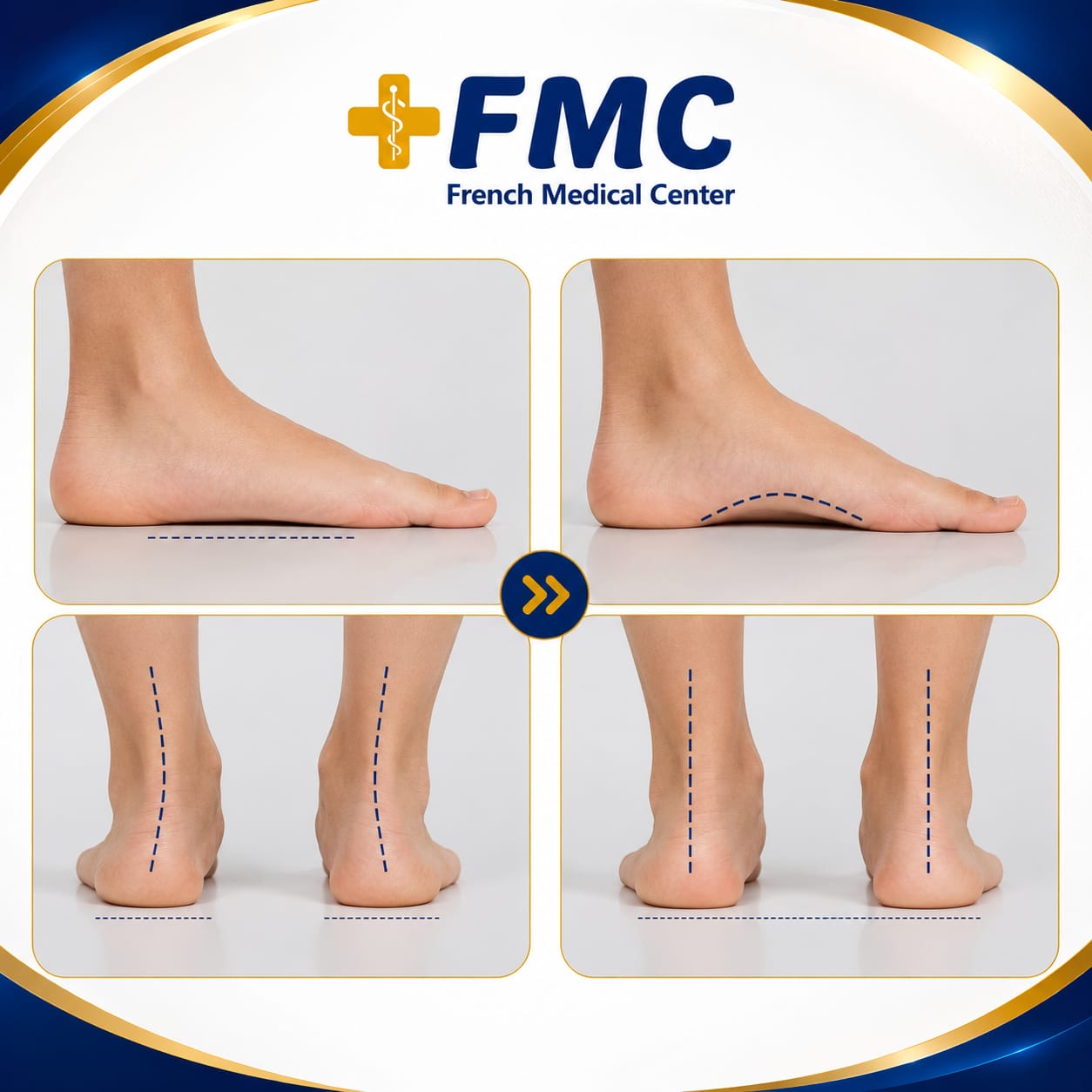
Flat feet are among the most common conditions in children, and they often improve spontaneously by age six as the arch of the foot develops and takes its normal shape. However, the problem may persist in a small percentage of children, causing mobility difficulties or recurring pain.
This leads parents to wonder, "Can flat feet be treated with exercises alone? Or is surgical intervention necessary?" In this regard, we have dedicated the following article to discussing ways to treat flat feet.
Can flat feet be treated with exercises alone?
The answer to the question, "Can flat feet be treated with exercises?" It depends on the cause and type of flat feet, which are:
Flexible Flat Feet
Flexible flat feet result from weak muscles and lax ligaments at this age. The natural arch of the foot disappears when sitting and resting, but becomes more prominent when standing and moving. Doctors recommend a conservative treatment program that includes a set of exercises.
Solid Flat Feet
The cause of rigid flat feet is deformities in the bones of the foot. The child usually complains of pain while walking, and their gait resembles that of a penguin. In this case, treatment primarily relies on surgical intervention to correct the deformities and reshape the foot, followed by a treatment program that includes flat foot exercises and physical therapy.
Therefore, we find the answer to the question, "Can flat feet be treated with exercises alone?" Exercise alone is insufficient for treatment. It is essential to consult a pediatric orthopedic specialist first to determine the cause of the problem and then the appropriate treatment protocol, which often includes exercises, whether as part of conservative treatment or after surgery.
What are the exercises for treating flat feet?
According to a recent study, consistently practicing flat foot exercises contributes to improving foot shape and correcting gait and movement within 8 weeks. Based on this, the American Academy of Orthopaedic Surgeons recommends a set of exercises, which we will explain in detail below:
Attic Stretching Exercises
The goal of flat foot treatment through exercise is to strengthen the muscles and stretch the tendon responsible for the natural arch of the foot. A child can perform these exercises as follows:
Stand upright facing a wall, placing one hand on it.
Place one foot forward and the other back, keeping the heel on the ground.
Bend the knee of the front foot until a stretch is felt in the back of the leg.
Hold this position for 30 seconds, then rest for another 30 seconds.
Repeat the exercise 10 times, preferably twice. Daily.
This exercise is performed by having the child sit upright in a chair, placing a golf or tennis ball under their foot, and then moving the foot forward and backward several times for about two minutes.
In addition to the previous exercises, flat feet can also be improved through the following practices:
Walking on tiptoes back and forth.
Standing up and down in place on tiptoes.
Running barefoot on sand.
Before practicing flat foot exercises, we advise you to:
Consult a doctor first to determine what is suitable for your child.
Perform the exercises slowly and correctly.
Perform the exercises consistently to achieve the best results.
Additional Exercises for Flat Feet
It is worth noting that practicing martial arts, in particular, helps in treating flat feet in children. These include the following sports:
Judo.
Taekwondo.
Gymnastics.
Ballet.
Basic Therapies Alongside Flat Foot Exercises
As mentioned above, treating flat feet with exercises is part of The treatment plan, if the child experiences recurring pain or difficulty walking normally, may include the following:
Anti-inflammatory medications such as paracetamol.
Physical therapy sessions.
Wearing specialized flat foot shoes, with an insole if necessary.
Surgical treatment.
Finally, treating flat feet with exercises improves gait and helps alleviate associated pain. If your child has flat feet, we advise you to consult a pediatric flat foot specialist and adhere to the complete treatment program to ensure the best outcome. Remember that exercise alone is not sufficient for treatment.