


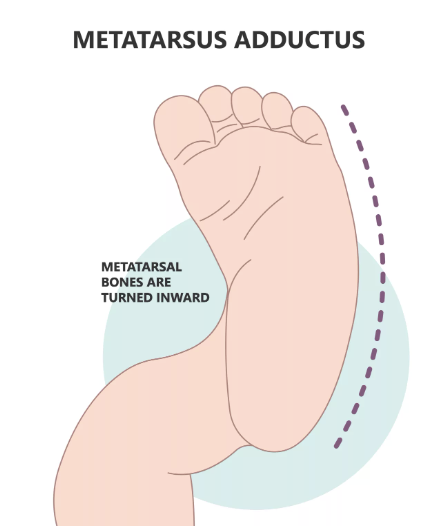
What Is Metatarsus Adductus?
Metatarsus adductus, also called metatarsus varus, is a common congenital foot deformity in which the forefoot turns inward. It may be classified as flexible (can be straightened by hand) or nonflexible (cannot be straightened manually).
What Causes Metatarsus Adductus?
The exact cause is unknown. It occurs in 1–2 per 1,000 live births, more common in first‑born children.
Most infants do not require treatment, but they may have a higher risk of developmental dysplasia of the hip, where the femoral head slips in and out of a shallow hip socket.
How Is It Diagnosed?
Diagnosis is made through physical examination by a specialist at المركز الطبي الفرنسي.
Evaluation includes:
- Complete birth history
- Family history of similar deformities
X‑rays are usually unnecessary except in nonflexible cases.
Clinical Signs
- High arch
- Big toe deviates inward
- Forefoot aligns with heel under gentle pressure (flexible)
- Difficulty aligning forefoot (nonflexible)
Treatment Options
Treatment depends on:
- Age
- Severity
- Child’s tolerance
- Expected progression
- Parent preference
Available Treatments
- Observation for flexible feet
- Stretching / passive manipulation exercises
- Casting
- Surgery for severe rigid cases
Most cases resolve spontaneously.
Passive Manipulation
Parents may be taught exercises during diaper changes.
Sleeping Position Adjustments
Side‑lying positioning may be recommended.
Casting
Used when stretching fails:
- Long‑leg casts
- Changed every 1–2 weeks
- Followed by straight‑last shoes
Surgery
For very rigid deformities:
- Release forefoot joints
- Apply casts post‑surgery
Long‑Term Outlook
Over 90% of cases resolve naturally. Treatment depends on foot flexibility.